
I Don’t Care If We Win

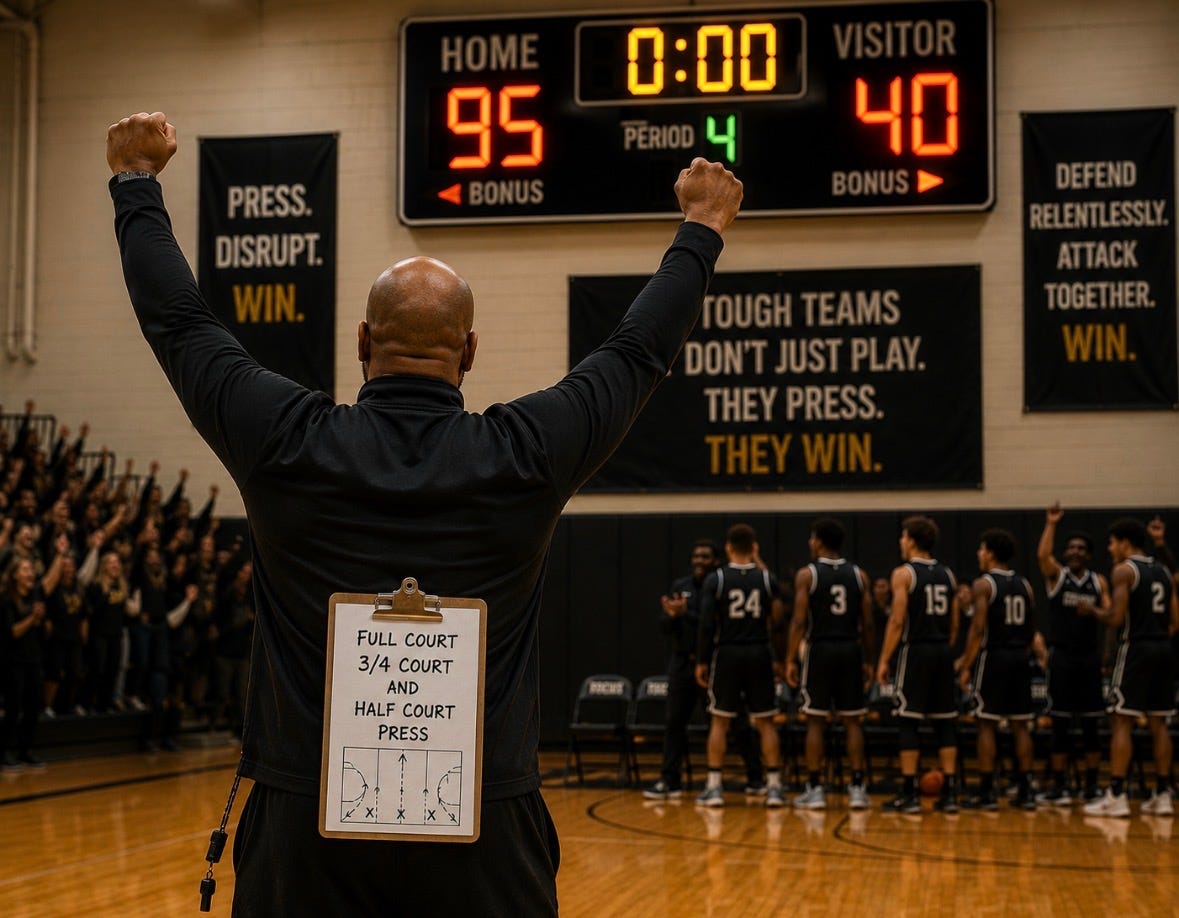
Heard it in a gym this weekend. One coach to another, before the ball went up. “I don’t care about winning today, I’m just here to evaluate.”
Then he cranked the full court press against a team that couldn’t break it and went three deep off his bench.
The sentence was correct. It’s the right reason to be in a summer gym. You’re not chasing a trophy in June, you’re trying to learn what your team does well and what it can’t do yet. Say that sentence and mean it and the whole weekend changes shape.
He didn’t mean it. Watch the moves he actually reached for.
The press is a choice to win. It exists to run up the margin against a team that can’t punish it, and he’d never run that same trap against a real opponent because he knows it’s bad. He only pressed because the gap was already there.
The short bench is a choice to win too. That one’s harder to hide. If you are really evaluating, the back of your bench is exactly who you need on the floor. Those are the players you have the least information on. A coach who meant the sentence plays ten, eleven, twelve and watches what the unknowns do under real minutes. This one played eight, and the last three or four on the roster never got off the bench. Cheerleaders in jerseys. He spent the game confirming that his top guys are good, which he already knew, and benched the only players who could have taught him something new.
So he didn’t evaluate anything. He walked out with a thirty point win and not one piece of information he didn’t walk in with. The sentence wasn’t a philosophy. It was a cover story, the thing you say so a beatdown can pass for coaching.
Here’s the part worth keeping. A coach’s real philosophy is not the sentence he says to the other coach. It’s the move he reaches for when he thinks the game doesn’t count. This one reached for a gimmick press and an eight man rotation. Now you know exactly who he is in March, because in March he’ll say the same sentence and do the same thing.
The summer tells on people. Two or three games is plenty to read a team’s tendencies, and it’s plenty to read a coach’s. The press when ahead, the hero ball guard who never comes out, the bench that checks out down ten, the eight games in three days. Every one of those is a tell. The weekend you think you’re using to scout other teams is also a weekend where everyone is scouting you, whether you meant to show them or not.
If you actually want to evaluate, it’s not complicated. Turn the difficulty up, not down. Play opponents who ask real questions instead of teams you can press into the ground. Turn the rotation wide, not narrow. Empty the bench so the live reps land on the players you’re unsure about, not the ones you’ve already figured out. And play a few games, not eight, because you have your honest answer by the second or third one anyway. Everything after that is tired legs and no new answers.
And when the schedule hands you a mismatch anyway, that game is its own test. The other team can’t guard you and can’t score on you, and the pressing coach treats that as a green light for runouts. It’s the opposite. A blowout is the safest place you will ever coach to try something hard. The score can’t hurt you, which makes this the one game where you can afford to be bad at something on purpose. Spend the margin on difficulty, not on dunks.
They can’t make the game harder on you, so you make it harder on yourself. Install the new defense live, the matchup zone or the switch everything look, and find out what holds up when real bodies move at real speed instead of against air in practice. A blown coverage here costs you a basket you can easily afford, not a close game in February.
Move your most inexperienced kid to point. You are putting the player you know the least about into the highest decision making spot on the floor, at the moment the game is safe enough to let the mistakes happen. That is evaluation and development in the same possession, and you leave knowing something real about a player you were unsure about.
Constrain the offense so the talent gap stops doing the work for you. Make the ball touch the second or third side before anyone shoots, and hero ball dies without you saying a word. Require a paint touch before every three, and you are training rim pressure and inside out decision making instead of the first open look a weak defense hands you.
That’s the floor. The other half is how you keep score.
The scoreboard is a liar in a blowout. It says you won by 30 whether you played beautiful basketball or hunted cheap steals all night, so stop letting it be the scoreboard. Set a team goal the mismatch can’t hand you for free and grade the game against that instead.
This is how a win can feel like a loss, and why it should. You won by 30 but asked for 15 defensive rebounds and got 9. You won by 30 but wanted 20 assists and got 11 because everyone was chasing their own runout. The margin says you cruised. The goal says you were sloppy and selfish, and the goal is the one telling the truth. You found it out for free, inside a win, where nobody got hurt finding out.
The goal only works if the talent gap can’t inflate it. Defensive rebounds are effort and box outs, exactly as hard against a weak team as a good one. Charges display toughness and position, and you can’t fake one, you have to be early and you have to want it. Assists, and rewarding the extra pass, are the direct answer to the runout habit, and they pair with the second side rule. The rule forces the movement, the goal rewards the pass the movement creates. Points, margin, and steals off a press all get easier against a weaker team, so they are worthless as goals. Pick the one number in the gym the talent gap can’t touch, and make the team go for it.
Run the constraints and the goal together and the blowout flips. The constraint changes what your players do. The goal changes what they are judged against. Now the easiest game on the schedule is the most demanding one in the gym, a game your team can fail even while the scoreboard says they won going away.
Volume is where most schedules get it backward. Seven or eight games in three days was never built for development. It was reverse engineered from a venue’s weekend and an entry fee. By game five everybody’s legs are gone, and you can no longer tell the difference between a player who can’t do something and a player who’s just cooked. You’re not evaluating anymore, you’re just watching tired kids play tired kids.
The good news in all of it is that an honest evaluation is cheaper than a fake one. Fewer games, wider bench, harder opponents, no gimmicks. It costs less and tells you more.
So when you say you’re here to evaluate, check the move you reach for next. That’s the part the other coach is actually listening to.